

Summary
Resistance to personal care is one of the most common and stressful challenges families face when a parent moves into senior living. At Atria Briarcliff Manor, Resident Services Assistant Alice Jordan has built a quiet reputation for doing what others cannot: earning the trust of residents who have refused care from everyone else.
If you’ve ever tried to convince an aging parent to accept help with bathing or personal hygiene, you already know how that conversation can go.
They say they’re fine. They say they don’t need anyone. And sometimes, no matter how clearly you can see that they do, nothing you say seems to move them.
It’s one of the most common concerns families bring to senior living communities:
- What if my parent refuses to let anyone help them?
- Will staff have the patience to handle a difficult situation?
- What happens when a resident says no?
- How do caregivers help a resident accept care without embarrassing them?
At Atria Briarcliff Manor in Westchester County, New York, one caregiver's story offers a meaningful answer to all of those questions.
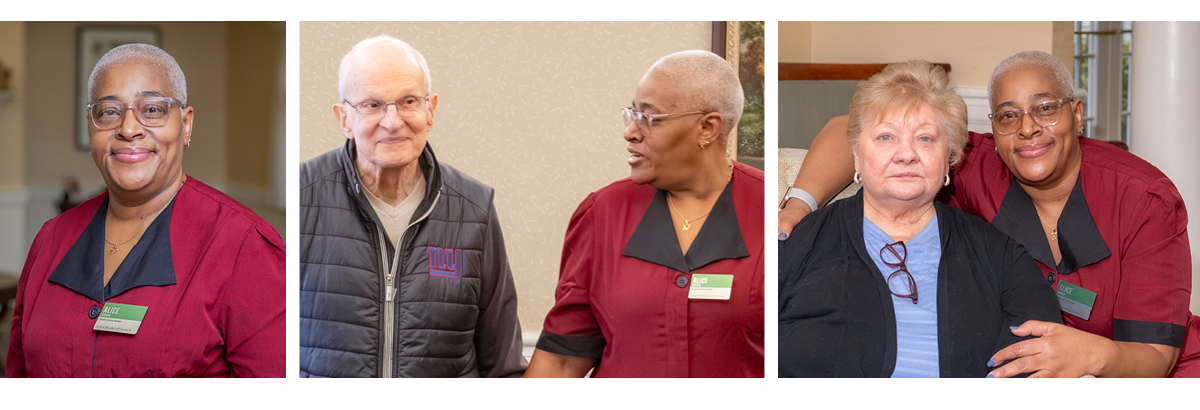
Meet Alice: the caregiver residents specifically request
Resident Services Assistant Alice Jordan was recently named an Atria Uncommon Hospitality winner – an award that recognizes employees who make an extraordinary difference in residents’ daily lives. She has worked at Atria Briarcliff Manor long enough to become something of a legend on the care team.
She doesn’t rely on authority or routine. She relies on patience, attentiveness and an instinct for meeting people exactly where they are.
According to Community Sales Director Kate Bacon, residents who had adamantly refused care from anyone on staff – including bathing and personal hygiene assistance – eventually not only accepted help from Alice, but also began requesting her by name.
“She works her magic with residents who refuse care. She has such a good way with them. There’s just something about her that puts them at ease – she’s won over the toughest of the tough.”
That’s not a one-time story. Bacon emphasizes that this is who Alice is, consistently, across every resident she works with.
Why some older adults resist personal care
Resistance to personal care is far more common than many families expect – and it rarely has a single explanation.
Some older adults have lived independently for years. Accepting help from a stranger with something as intimate as bathing can feel like a profound loss of control, privacy or identity. Others may be in denial about how much their needs have changed. Still others arrive at a senior living community already carrying anxiety or frustration that has nothing to do with the caregiver standing in front of them.
As Bacon explains, resistance can look different depending on the person and the situation:
- Some residents arrive at a community already reluctant, having resisted help at home for months
- Others age in place within the community and gradually need more support, even as they insist they don’t
- For many, resistance is tied to pride, fear of vulnerability or a sense that accepting help means giving something up permanently
- Sometimes the hesitation stems from a lack of trust with a specific caregiver rather than a blanket refusal of care
None of this means someone cannot thrive in senior living. It often just means they need someone who knows how to build trust slowly, gently and on the resident’s own terms.
What compassionate caregiving actually looks like in practice
Families touring senior living communities often hear reassuring language about care and support. What’s harder to convey in a tour or a brochure is what caregiving actually looks like on a Tuesday morning when a resident is having a difficult day.
Bacon describes Alice’s approach as calm, unhurried and tailored to each person. Rather than pushing through resistance, Alice steps back and tries a different angle. She reads the situation and adapts.
“She uses a very gentle approach. She’ll reapproach and come at it from different angles until she figures out what works best for that particular resident. She’s patient – beyond patient. I could not do her job.”
In practice, that kind of caregiving can include:
- Returning to a conversation later, calmly, after an initial refusal
- Learning what each resident’s specific concerns or preferences are
- Adjusting language, timing and approach based on the individual
- Moving at the resident’s pace rather than a scheduled pace
- Protecting dignity during intimate personal care, every single time
- Building familiarity and trust over weeks and months, not just one interaction
It’s not about refusing to take no for an answer. It’s about figuring out why someone is saying no and finding a way forward that respects them.
Why trust between residents and caregivers matters so much
Personal care is intimate. There’s no way around that. Accepting help with bathing or hygiene requires a level of trust that doesn’t develop overnight and can’t be manufactured through protocol or policy.
Bacon knows this from years of experience. Before joining Atria, she spent nine years in skilled nursing, where she saw the full spectrum of what caregiving relationships can look like.
“To have that kind of trust in somebody and have that rapport is key.”
That trust doesn’t just matter for residents. It matters enormously for families. Knowing that a parent has built a genuine connection with the person helping them each day can take the edge off one of the most stressful decisions a family makes.
It can also change a resident’s entire experience of where they live. Bacon notes that caregivers like Alice create something more than a working routine – they create a sense of safety that extends beyond any single interaction.
What to look for when touring a senior living community
It’s genuinely difficult to assess caregiving quality from a single tour. You can see the apartments, the dining room and the program schedule. The harder thing to evaluate is how staff respond when a resident is having a hard day.
Families comparing communities may also find it helpful to understand the differences between senior living options before they begin touring.
The questions that reveal the most about a community’s culture are often the ones people don’t think to ask. Consider asking:
- How do caregivers respond when a resident refuses assistance?
- How does staff support residents who are anxious or resistant to care?
- How long have caregivers worked here, and what does retention look like?
- How do team members get to know a new resident’s preferences and needs?
- Can you tell me about a time when a caregiver made a real difference for a difficult situation?
Stories like Alice’s are exactly what those questions are designed to uncover. They tell you more about what a community actually values than any brochure or amenity list.
The small moments that shape how a community feels
When people look back on why they chose a particular senior living community – or why they feel their parent is truly happy there – it’s rarely the square footage or the amenities that come up first.
It’s the people.
- The caregiver who remembers how someone takes their coffee
- The staff member who notices when a resident seems quieter than usual
- The person who sits with someone through a hard moment instead of moving on to the next task
- The team member who volunteers to stay through a snowstorm because residents need them there
That last one isn’t hypothetical. During a major snowstorm, Alice and other Atria Briarcliff Manor team members chose to sleep at the community on air mattresses rather than leave residents without the care and support they needed. Bacon describes them as “rocks” during that period.
That kind of commitment is hard to quantify. But it’s exactly what families are hoping to find when they’re searching for a place they can trust with someone they love. It’s also what Atria’s Uncommon Hospitality award was created to recognize.
This isn’t a one-time story – it’s a reflection of culture
One of the most meaningful things Bacon says about Alice is also the simplest: This isn’t a special effort reserved for difficult situations. It’s how she approaches every resident, every day.
“She consistently does this for everybody. It’s part of who she is.”
It’s also why Alice was selected as Atria’s Uncommon Hospitality winner. Her impact isn’t measured by a single moment, but by the trust she builds with residents.
That consistency matters. It’s the difference between a community where exceptional care is rare and one where it’s the expectation.
Bacon credits the broader team at Atria Briarcliff Manor for embodying the same spirit. After nearly a decade in skilled nursing, she knows how rare that kind of dedication is.
“I’m so proud of my team. They genuinely love what they do. Our residents feel that.”
Find a senior living community you can trust in New York
Whether you’re exploring supportive living, independent living or memory care, finding the right community often comes down to one question: Do you trust the people who will be caring for your family member?
Alice’s story is one example of how trust is built – one resident and one interaction at a time.
Learn more about Atria’s senior living and assisted living communities throughout New York and find the right fit for your family.
You might also like
Want to learn more about life at Atria Senior Living?
